


T-shirt Factory Partnering Guide
Introduction
Nowadays, more and more apparel brands, offline retailers, event planners, and entrepreneurial teams are seeking a clear "T-shirt Factory Partnering Guide," hoping to efficiently connect with T-Shirt Factories that combine professional production capabilities, flexible partnership models, and stable delivery guarantees. Compared to traditional piecemeal sourcing, high-quality T-shirt factories not only offer a diverse selection of fabrics and craftsmanship, but also support full-chain collaboration from style design to mass production, meeting customized needs in various scenarios. Dongguan Siyinghong Garment, with over a decade of experience in T-shirt production and a mature partnership system, provides clients with a one-stop service from demand communication, sample production, to mass delivery. Whether it's daily brand replenishment, event-specific customization, or small-batch trial production for entrepreneurial teams, we can match them with precise partnership solutions. Below, we will break down the practical "T-shirt Factory Partnering Guide" for you, covering aspects such as factory screening, partnership process, customization support, quality control, and minimum order quantity policy, to help you quickly find the right partner.
How to select suitable T-shirt factory partners?
Before embarking on a T-shirt partnership, the core starting point of the "T-shirt Factory Partnering Guide" is "How to Select a Suitable Factory." Many clients encounter issues such as inconsistent quality, delayed delivery, and inefficient communication due to improper initial screening. Therefore, it's important to comprehensively evaluate the factory's capabilities from multiple perspectives.
When choosing a professional T-shirt factory like Dongguan Siyinghong Garment, focus on the following four key aspects:
1. Production Qualifications and Experience: Verify whether the factory possesses basic qualifications such as a clothing production license and ISO quality certification. Also, understand their years of experience specializing in T-shirt production and their case studies (e.g., whether they have served similar brands and experience in niche categories). Avoid partnering with "small workshop-style" factories.
2. Production Capacity and Delivery Flexibility: Based on your order volume (e.g., a single trial run of 50 pieces or a bulk purchase of 1,000 pieces), confirm whether the factory's monthly production capacity matches your order volume. Also, understand their ability to respond to urgent orders (e.g., whether they can complete small batches within 7 days) to ensure a stable supply.
3. Process and Fabric Inventory: Inquire about the T-shirt production capabilities the factory offers. Consider the T-shirt process (e.g., screen printing, digital direct printing, heat transfer) and fabric type (e.g., pure cotton, combed cotton, polyester-cotton blend) to determine whether it meets your product positioning (e.g., high-end brands require combed cotton, while fast-moving consumer goods require cost-effective polyester-cotton).
4. Partner service details: Inquire about whether the factory offers free sample making, dedicated customer service, and after-sales defective product handling policies. These details directly impact the partnership experience and subsequent risk management.
Sifting through these criteria can effectively reduce partnership risks and ensure you find a T-shirt factory partner that meets your needs and provides reliable service.
T-shirt Factory Partnering Guide:Analysis of the entire cooperation process
A clear partnership process is key to efficient collaboration with T-shirt factories and forms the core of the "T-shirt Factory Partnering Guide." Many clients' lack of understanding of the process leads to back-and-forth communication and prolonged production cycles. Standardized processes make collaboration smoother and more manageable.
Dongguan Siyinghong Garment has developed a five-step standardized process for T-shirt collaborations to accommodate the needs of clients of varying sizes:
1. Precise Matching: Clients specify their desired T-shirt style (e.g., crew neck, V-neck, hooded), fabric, finish (e.g., logo or pattern printing), order quantity, delivery time, and any special requirements (e.g., eco-friendly dyes, custom sizes) through the official website form, email, or dedicated customer service. The factory will then provide fabric and process samples for reference.
2. Sample Confirmation: The factory will produce 1-3 sets of T-shirts based on the requested pattern. We will prepare a sample, annotated with fabric composition, process details, and dimensional parameters, and send it to the customer for testing. Customers may request modifications (such as adjusting pattern placement or changing fabric thickness), and the factory will optimize the sample free of charge until it meets the standards.
3. Contract Signing: After both parties confirm the sample, quotation (including unit price, total cost, and payment method), delivery time, logistics method, and after-sales policy, a formal cooperation contract will be signed to clarify the rights and responsibilities of both parties and ensure compliance with the law.
4. Mass Production Monitoring: After production begins, the factory will regularly update the customer on progress (such as fabric cutting, printing, and sewing completion). Photo or video feedback will be provided at key milestones (such as mid-production and finished product sampling) to ensure the customer has real-time access to production status.
5. Finished Product Delivery and After-Sales Service: After production is completed, the factory will conduct a full inspection (checking pattern clarity, seam strength, and dimensional deviation). Once qualified, the product will be shipped according to the agreed logistics system and provided with a tracking number. If the customer discovers a small number of defective items after delivery, they can provide proof within 7 days for the factory to reissue them free of charge or credit the next payment.
Requirements document preparation tips
To reduce communication errors, customers are advised to prepare clear demand documents in advance: marking T-shirt style drawings (with reference sample links), fabric parameters (such as gram weight 200g pure cotton), craftsmanship details (such as logo position on the left chest, size 8cm×8cm) and order quantity breakdown (such as 20% for size S and 30% for size M), so that the factory can quickly and accurately understand the needs.
The importance of small batch trial production
When collaborating with a T-shirt factory for the first time, it is recommended to choose a small-batch trial production (such as 50-100 pieces) to verify the factory's quality control, process fidelity, and delivery speed through trial production, and then gradually expand the scale of cooperation to reduce long-term cooperation risks.
Flexible choice of logistics solutions
Based on the order volume and delivery time requirements, the factory can provide a variety of logistics solutions: small-volume orders can choose international express delivery (3-7 days), large-volume orders can choose sea transportation (20-30 days). At the same time, we can assist with customs clearance procedures to ensure smooth delivery of goods.
Core partnership support for customized T-shirt production
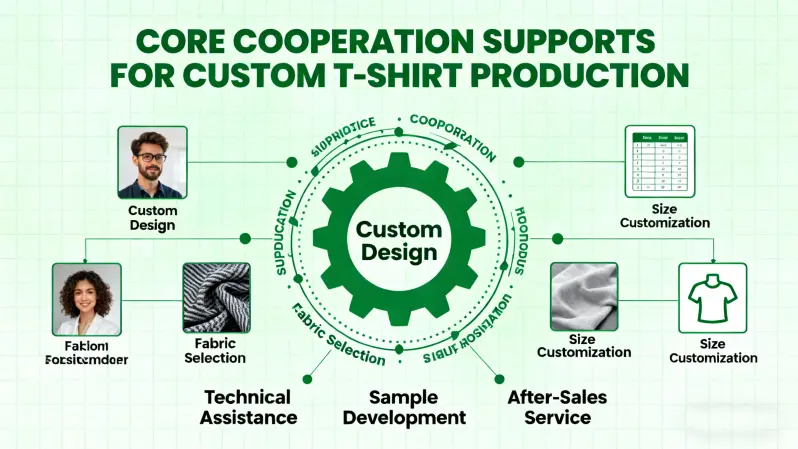
In the "T-shirt Factory Partnering Guide," "customization support capabilities" are key to distinguishing ordinary factories from high-quality ones. Whether it's a brand-specific design, event-themed graphics, or special functional requirements (such as sun protection and breathability), T-shirt factories need to provide professional customization support. Dongguan Siyinghong Garment offers three core support options for customized T-shirt production to meet diverse needs:
1. Full-Category Process Support: Covering all common T-shirt processing methods, including screen printing (suitable for large-scale solid-color patterns, low cost and high efficiency), digital direct printing (suitable for complex color patterns, high fidelity and no glue), heat transfer (suitable for special effects such as hot stamping, gold/silver foil), and embroidery (suitable for logos or small patterns, providing a high-quality finish). Customers can choose the appropriate process based on the complexity of the design and budget.
2. Fabric and Style Customization: In addition to standard pure cotton and polyester-cotton fabrics, we also offer specialized fabrics (such as organic cotton, bamboo fiber, and sun-protective fabrics). We also support detailed adjustments (such as adding pockets, modifying the neckline curve, and customizing the cuff ribbing color) to create differentiated products.
3. Design Optimization Assistance: If customers only have a preliminary design idea (such as a hand-drawn pattern or text logo), our professional design team can provide optimization services (such as adjusting the pattern proportions, matching Pantone colors, and optimizing the print size to fit the T-shirt pattern) to ensure the final product looks great.
Cost and cycle of customized process
The costs and production cycles of different processes are different: screen printing (low unit price for bulk orders, cycle time 3-5 days), digital direct printing (flexible for small batches, cycle time 5-7 days), embroidery (complex process, cycle time 7-10 days). Before cooperation, the factory will provide detailed process quotations and cycle estimates to help customers balance needs and budgets.
Feasibility assessment for special needs
For customers' special customization needs (such as environmentally friendly dyes, Class A standards for infant T-shirts, and oversized customization), the factory will conduct a feasibility assessment in advance and provide compliant fabric testing reports and process solutions to ensure that customized products meet industry standards and customer requirements.
Guarantee of sample modification
During the sample making stage, customers can enjoy free modification services (limited to 3 times). The factory will adjust the process or fabric according to the modification suggestions until the sample fully meets the customer's expectations, avoiding the risk of mass production due to sample deviation.
T-shirt Factory Partnering Guide:Key points of quality control
1.Quality is the core guarantee of T-shirt partnerships and is a key focus in the "T-shirt Factory Partnering Guide." Failure to maintain quality control at the factory can lead to problems such as pilling, pattern detachment, and sizing deviations, negatively impacting brand reputation and sales. Dongguan Siyinghong Garment has established a three-level quality control system, ensuring that every batch of T-shirts meets standards from source to finished product:
2. Raw Material Quality Inspection: Upon arrival, fabrics are inspected for composition (e.g., 100% cotton), weight deviation (no more than 5%), color fastness (washing/rubbing color fastness must be at least level 4), and defects (e.g., holes, uneven yarns). Unqualified fabrics are returned directly to the supplier.
3. Production Process Inspection: Dedicated personnel conduct real-time inspections of cutting (checking for size deviation, ≤1cm), printing/embroidery (checking for pattern position deviation, ≤0.5cm, and no missing or misprinted patterns), and sewing (checking for stitch density, ≥8 stitches per 3cm, and no skipped or broken threads). Any defects identified are immediately rectified.
4. Finished Product Inspection: After batch production is completed, a 10% inspection is conducted. We will randomly sample the finished product to check its size (e.g. length and chest circumference deviation ≤ 2cm), workmanship integrity (no falling of patterns, no snagging of embroidery), and appearance neatness (no stains or loose threads). Products will only be shipped after passing the full inspection.

Clear agreement on quality standards
Before cooperation, the factory will clarify the quality standards with customers (such as referring to AATCC textile testing standards and GB/T 29862 clothing standards) and indicate them in the contract to avoid disputes over quality certification in the future.
Third-party testing support
If customers have higher quality requirements (such as exporting to the European and American markets), the factory can assist in contacting third-party testing agencies (such as SGS and Intertek) to test the T-shirts for fabric composition, formaldehyde content, color fastness, etc., and provide authoritative test reports.
After-sales quality traceability
Each batch of orders has a unique production number. If customers report quality issues, the number can be used to trace the production process (such as fabric batch, operator, and inspection records) to quickly locate the cause of the problem and develop an improvement plan to avoid the recurrence of similar problems.
T-shirt factory cooperation plan with no minimum order quantity limit
Many startup brands, small teams, or individual clients seeking a "T-shirt Factory Partnering Guide" are most concerned about minimum order quantities. Traditional factories often require minimum orders of hundreds of pieces, making it difficult to meet small batch demands. To address this pain point, Dongguan Siyinghong Garment has launched a "no minimum order quantity" T-shirt partnership program, allowing clients of all sizes to collaborate flexibly. The core advantages of this solution include:
1. No minimum order quantity: Supports sample customization of 1 piece and small batch production of 10 pieces, eliminating the worry of "order rejection due to small quantities." This solution is particularly suitable for startup brands looking for trial production and testing, event customization (e.g., 20 pieces for company team-building events, 30 pieces for campus events), and personal DIY customization.
2. Transparent pricing with no premium: Small batch orders are priced according to a unified quotation system, with no additional premium (e.g., an order of 10 pieces is only 10%-15% higher than an order of 100 pieces), allowing customers to flexibly control order quantities based on their budget.
3. Guaranteed delivery time: Even small batch orders of 10 pieces are guaranteed to be delivered within 7-10 days (standard processing). Urgent orders can be expedited to 3-5 days to meet customer timelines.
Cost control techniques for small batch orders
For small-batch customers, the factory will provide cost control suggestions: such as choosing conventional fabrics (20%-30% lower in cost than special fabrics), simplifying the process (such as screen printing is cheaper than digital direct printing), and unifying size ratios (reducing cutting complexity), thereby reducing procurement costs while ensuring quality.
Preferential prices for long-term cooperation
If the customer subsequently expands the order quantity (for example, from 10 pieces to 100 pieces or 1,000 pieces), the factory will provide tiered price discounts based on the cumulative order quantity (for example, if the cumulative order quantity is more than 500 pieces, the unit price will be reduced by 5%-8%) to support the customer's long-term development.
Flexible payment options
Small batch orders support "50% advance payment + 50% balance (paid before shipment)", and long-term customers can apply for "30% advance payment + 70% balance (paid within 7 days after receipt)" to reduce customers' financial pressure.
Conclusion
With the above information, you've mastered the practical "T-shirt Factory Partnering Guide." From selecting suitable factories and breaking down the partnership process to customized support, quality control, and even the no-MOQ solution, every step is clearly outlined. As a dedicated T-shirt manufacturer, Dongguan Siyinghong Garment prioritizes customer needs, providing flexible, professional, and reliable partnership services. Whether you're looking for a trial run for a startup brand, bulk replenishment for an established brand, or customizing for an event, we've got a solution for you. Through standardized processes, strict quality control, and a no-MOQ policy, we help our clients mitigate partnership risks, enhance product competitiveness, and achieve long-term, stable, and mutually beneficial partnerships.
FAQ
FAQ 1:How to quickly connect with a T-shirt factory that meets your needs?
You can get screening directions by searching "T-shirt Factory Partnering Guide", or contact Dongguan Siyinghong Garment directly with your T-shirt style, order quantity, and craft requirements. We will provide a customized cooperation plan and quotation within 24 hours.
FAQ 2:Is the quality of orders with no minimum order quantity guaranteed?
Yes. Regardless of order volume, we strictly implement a "three-level quality control system" that inspects everything from raw materials to finished product. This ensures consistent quality for both small and large orders, and we support production only after sample confirmation.
FAQ 3:Can you provide support for the production and certification of T-shirts exported to the European and American markets?
Yes. We can produce T-shirts that meet European and American standards (e.g., formaldehyde content ≤ 20ppm, color fastness up to Class 4), and assist with obtaining certifications such as CE and CPSIA. We also provide third-party testing reports to ensure smooth customs clearance.
FAQ 4:How to deal with the copyright issues of customized T-shirt patterns?
Customers must ensure that the patterns and logos they provide have legal copyright. We will sign a Copyright Confirmation with the customer. If the customer needs to use an authorized pattern, they must provide proof of authorization to avoid copyright disputes.