







Textile fabric gram weight is insufficient, pay attention to these 8 big reasons!
The shortage of fabric weight, although not a big problem, the impact of conventional trade is not big, but in some export orders or specific trade, weight is often the most critical link, often because there are enterprises not easy to receive a large order, but finally because of the return or claim of weight. The following are the reasons for the weight deficiency.
grammes per square metre
To ze whether the yarn branches and density are correct, cut the two warp yarn and two ft yarn along the four sides into a square or square, measure its length and width (cm) with a steel ruler, then find the area of the sample (square cm), and put it on the balance to weigh (milligrams)
Weight of sample fabric per square meter = weight 1000 (area 10000) = weight area 10;
1.Use the calculation method and the tools together
For example: a sample cloth is 7 centimeters long, 8 centimeters wide, weighed for 772 milligrams, then the finished gram weight of this sample cloth per square meter =772 (78) 10=138 grams
2.Tool method
With the garden plate cutting sampling knife, put the cloth sample below, rotate clockwise a few times, take the garden shape cloth in three places (20CM outside the cloth edge or tail), and put it on the electronic balance scale to measure the specific data.
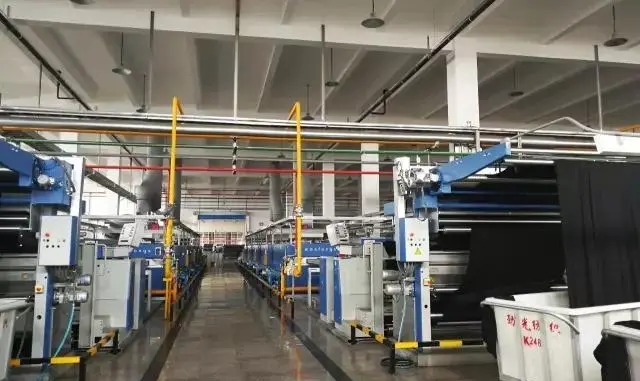
Calculate the color Booker weight
The weight of the fabric per unit area, generally expressed in the number of grams per square meter (g / m2) or ounces per square yard (oz / Y2). The actual size of the weight is related to the thickness of cotton, yarn support, finished door width and finishing process. It is simple to calculate the weight:
1.Non-elastic cloth color cloth gram weight calculation:
(Number of grey cloth / warp support + number of grey cloth / warp support) * 24.3
For example: calculate 20 * 16 / 128 * 60 / 63 " gram weight.
(128/20 + 60/16)*24.3≈246.6(g/m2)
Its gram weight is approximately 242-248g / m2.
2.Heavy elastic cloth finished product
Upper reed / finished door * (upper density / warp support * 22.17 + ft * 21.4)
For example: calculate the variety C78 " 20 * 16 + 70D / 116 * 48 grams weight
78/58*(116/20*22.17+48/16*21.4)≈259(g/m2)
Its actual gram weight is approximately 260-265g / m2.
Note: 78 "is the upper machine reed, and the finished door width is 58"
Simple calculation
For simple calculation formula cloth weight and the finished cloth sample weight, the difference within ± 5 grams is within the normal range. The big difference requires careful analysis, and several rules are summarized according to our years of experience:
In general, the difference within ± 5 grams is more normal.
If the difference is large, it should be analyzed, the principle is as follows: the combed close yarn difference is slightly smaller.
(1) If the conversion constant of polyester cotton or polyester brocade blended yarn and chemical fiber yarn is greater than 583.1 of pure cotton, the other yarn of the same branch is large, and the calculated weight is smaller than the actual weight;
(2) The femoral thread is made of two or more single yarn twisted. Due to the twist, the actual yarn is thick, and the calculated weight is smaller than the actual weight. When the warp yarn is strands, the difference is large;
(3) airflow spinning belongs to short staple fiber yarn, in the printing and dyeing before the processing and cooking loss, its calculated weight is greater than the actual name;
(4) After washing, the gram weight is about 5-6.5% larger;
(5) When dyeing the dark color, due to the weight of the dye, the calculated weight is slightly larger than the actual weight;
(6) The calculated weight of the bleached blanks and the light-color blanks is slightly larger than the actual weight;
(7) The gram weight after coating is weighted by 3-7%;
(8) Heavy weight and light weight of 3.5-6% after grinding;
eason for the reduction of finished product gram weight
① Pretreatment stretching results in a reduction in latitude density.
② The finished door width is too wide.
③ Excessive base concentration and high temperature after the process will cause damage to the yarn fiber.
④ When the original yarn is purchased, the yarn is too thin. For example, the actual measurement of 40S is only 41S.
⑤ The original yarn wears in the weaving process is large, which will lead to excessive feathers, leading to thinning and low weight.
⑥ In the dyeing process, color change and peeling will lead to large yarn loss and lead to yarn thinning.
⑦ In the process of burning hair, the burning fire is too large to cause the dry cloth surface and the thinning.
⑧ The damage to the cloth surface in the scratching process and grinding process.